Judiciary Groans As Buhari Delays Judges’ Appointments
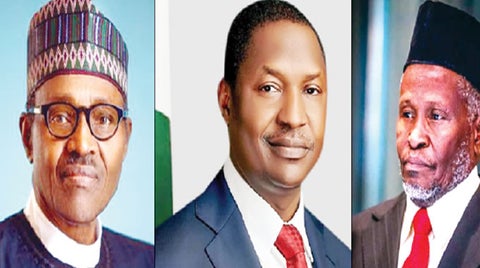
If the drafters of the Nigerian Constitution envisaged a situation like currently playing out regarding judicial appointments, they might perhaps have made a provision to possess acting Supreme Court Justices.
Since his assumption of office as President in May 2015, Major General Muhammadu Buhari (retd.) has exploited constitutional provisionswhich provides room for heads of courts to be appointed in acting capacity, to inexplicably delay the appointment process.
The Constitution empowers the Presidentto form judicial appointments to federal courts supported the advice of the National Judicial Council.
But Buhari’s consistent pattern of unexplained delayswithin the handling of the appointments has ensured that no head of court appointed by the regime since 2015 ever stepped into office in substantive capacity without first acting for a period.
Sadly for the Justices of the Supreme Court, who consistently groana few huge workload, there's no constitutional provision that permits candidates that are recommended by the NJC to lend helping hands in acting capacity, pending when the President would clear them for substantive appointment.
Steady decline
Buhari’s regime inherited a Supreme Court of 17 Justices in May 2015.
This wasan honest number that was only in need of four to form the court’s complement of 21 Justices.
Butrather than reaching the complete complement, the amount has rapidly declined to 12, while the amount of appeals regularly filed at the court remains ever-increasing.
Under the Buhari regime, 10 Justices have retired from the apex court’s bench, between November 2016 and April 2020.
Conversely, only fiveare appointed between November 2016 and January 2019, leaving the amount of Justices at its current balance of 12.
It is noteworthy that a minimumof 4 Justices also will be exiting the apex court’s bench within the next two years.
While Justices Olabode Rhodes-Vivour and Sylvester Ngwutaare going to be retiring as they attain their mandatory retirement age of 70 in 2021, Justices Mary Odili and Ejembi Eko will imitate in 2022.
If this trend of fast-declining number of Justices of the Supreme Courtisn't quickly checked with adequate replacement at the proper time, it means by the time Buhari leaves office in May 2023, the amount of Justices of the Supreme Court are going to be eight.
This is despite that three Justices of the apex court, including the incumbentjudge of Nigeria, Justice Tanko Muhammad, are going to be retiring shortly after Buhari leaves office in May 2023.
The last appointment to the Supreme Court bench was in January in 2019, when Justice Uwani Abba-Aji joined the bench.
But in 2019 alone, three Justices, including the immediate-past CJN, Justice Walter Onnoghen (retd.) exited, a development that has broughtthe amount of Justices of the apex court to its current 12.
The trend is gradually pushing the system to a situation where emergency appointments, with the tendency of sacrificing quality and competence on the altar of speed,are going to be the sole answer .
The foreseeable situation willend in to bringing new Justices on board en mass, a development which will likely see new Justices outnumbering the old ones on the bench.
This will be an unhealthy situation for the apex court whereit's necessary for brand spanking new Justices to possess a while to understudy senior colleagues, compare notes with them and learn from their wealth of experience before their retirement.
Buhari’s culture of delays
Buhari himselfseemed to be aware of the necessity to possess a Supreme Court with a complement of 21 Justices. Hence, in June 2019 when the apex court was having 16 Justices, Buhari wrote the CJN, Justice Tanko Muhammadu, to “initiate in earnest the method of appointing additional five Justices of the Supreme Court of Nigeria to form the complete complement of 21 Justices” as provided by the Constitution.
Following the President’s request, the NJC initiated the appointment process and atthe top of it, recommended four Justices of the Court of Appeal to him for appointment to the apex court’s bench.
The recommended candidates,consistent with a press release issued by the NJC’s Director, Information, Mr Soji Oye, at the top of the council’s meeting persisted October 22 and 23, 2019, were Justices Adamu Jauro, Emmanuel Agim, C. Oseji, and Helen Ogunwumiju.
It is almost eight months downthe road , Buhari has yet to forward the names of the candidates to the Senate for confirmation, and no explanation has been offered for the curious delay.
This pattern of undue delays first manifested under the Buhari regime when the then CJN, Justice Mahmud Mohammed, retired on attaining age 70 on November 10, 2016.
Prior tothe approaching on board of the Buhari regime, successive CJNs were inaugurated in substantive capacity by the sitting President on the day of the retirement of their predecessors.
The tradition changed withthe primary CJN’s appointment made by Buhari.
Despite that Justice Walter Onnoghen (retd.) was recommended to him by the NJC on October 13, 2016, Buhari waited till the retirement of his predecessor, Justice Mohammed, on November 10, 2016, to appoint Onnoghenbecause the acting CJN.
Onnoghen had to actbecause the CJN for four months due to Buhari’s unexplained delay in forwarding his name to the Senate for confirmation after the advice by the NJC.
Similarly, on October 23, 2019, the NJC recommended Justice John Tsoho for appointmentbecause the Chief Judge of the Federal supreme court , and Justice Benedict Kanyip because the President of the National Industrial Court.
But Justice Tsoho, who took overbecause the acting Chief Judge of the Federal supreme court on July 26, 2019, remained therein capacity for about five months, until he was appointed on December 13, 2019.
For Kanyip, he took overbecause the President of the NIC on October 1, 2019 and wasn't substantively sworn in until December 13, 2019.
Tsoho’s predecessor, Justice Adamu Abdul-Kafarati, who took overbecause the Chief Judge of the FHC in September 2017, acted for nine months before he was substantively appointed in June 2018.
Recently, the NJC, on April 23, 2020 recommended Justice Monica Dongban-Mensem,because the President of the Court of Appeal, but she wasn't confirmed until last week.
The incumbent CJN, Justice Muhammad, has been the luckiest under the Buhari regime, as he had his recommendation by the NJC ratified by Buhari, confirmed by the Senate and he was eventually sworn inbecause the substantive CJN within the month of July 2019.
Similar to the delay being suffered by the appointmentof 4 candidates recommended for the Supreme Court bench, the last set of 12 Justices appointed to the Court of Appeal bench in June 2018 had to attend for seven months for his or her recommendation by the NJC to be cleared by Buhari.
In the same vein,an inventory of 33 nominees for the bench of the supreme court of the Federal Capital Territory sent to Buhari by the NJC in April this year will clock two months by the top of June on Buhari’s table.
Although some lawyers petitioned Buhari, asking him to reject the list of the 33 nominees for being a product of an alleged faulty process, not a word has been said about it by the Presidency one and a half months after the list was sent to the President.
More workload, declining hands
The declining number of Justices of the Supreme Court runs in contrast with the increasing workload of the court.
At the valedictory court session held in honour of a retiring Justice of the court, Justice Amiru Sanusi, on February 3, 2020, the CJN, Justice Muhammad, expressed worry over the continued declinewithin the number of Justices of the court without replacement.
The CJN said, “You will recallthat hardly seven weeks ago, being Thursday, December 12, 2019, we assembled here to honour our brother, Justice Kumai Bayang Aka’ahs during a similar valedictory session. That ceremony painfully occasioned the depleting of our ranks at the Supreme Court. during a similar fashion, this session, too, is billed to further drastically reduce the amount of Supreme Court Justices to as low as 13.
“Thisisn't cheering news in sight of the ever-increasing number of appeals that flood the court on a day to day .”
Lawyers react
A Senior Advocate of Nigeria, Mr Chino Obiagwu, expressed worry over the handling of process of judicial appointments by Buhari.
He said, “We have always subscribed to having acomplement of the Supreme Court. there's no reason to not have a complement , not only because it'll make cases to maneuver faster, but also because it'll save the health of these who are there, because they're completely overworked. the quantity of cases coming to the Supreme Court isn't what a panel or 12 Justices should handle.
“The Constitution, in its wisdom, recommends acomplement of Justices; so why should we not have a complement of the Supreme Court Justices?
“You can see thatthey're very overworked. once they were doing political cases, see the amount of election judgments they produced.
“The courtis not any longer consistent because it need to be. Supreme Court Justice should be ready to have time and resources to supply judgments which will be policy statement of law. All that they are doing now's just to settle disputes and quickly conclude because they don’t have time.”
Obiagwu also said the judiciarywasn't the sole institution bearing the brunt of delayed appointments under the Buhari regime
He said, “So many parastatalslike the National Human Rights Commission are without boards. So, how does one expect them to perform optimally? No reason has been given why there should be delays.
“Look at the Niger Delta Development Commission, sucha crucial agency, doesn't have a cover till now. instead of fixing the board, they appointed an interim management committee which isn't known to law.
“So,i feel that the regime should be more law-abiding and follow statutes in order that there are often proper internal governance within the affairs of the agencies.”
Another lawyer, Tosin Ojaomo, blamedthe matter on the judiciary.
He said, “The problemis that the judiciary itself. there's a statutory role for the NJC to play.
“Until the NJC stands upto satisfy its statutory obligation, things will remain an equivalent . The judiciary isn't under the chief . it's an independent arm of state .
“The NJCmust take a re-evaluation at itself and it's been our campaign that the NJC should get up for the explanation for justice in Nigeria because they need a constitutional role to play and no-one can play the constitutional role for them.”
On his part, another lawyer, Sani Abubakar, said Buhari’s handling of judiciary appointments smacked ofethic .
He said, “It seems the Buhari government is characterised by double standards.as an example , you saw the delay in sending Justice Dongbam-Mesem’s name to the Senate for confirmation. an equivalent thing played call at Onnoghen’s appointment. But check out how they quickly confirmed Justice Tanko Muhammad. It leaves tons to be desired, allow us to speak the reality before God. it's injustice. You give the impression that you simply are somehow slanted towards your section of the country.
“Thatis that the impression and it's unfortunate especially at a time when the planet is condemning prejudice and bigotry within the aftermath of the killing of George Floyd within the us of America. this could not be tolerated or condoned. People should speak out against it.”
Since his assumption of office as President in May 2015, Major General Muhammadu Buhari (retd.) has exploited constitutional provisions
The Constitution empowers the President
But Buhari’s consistent pattern of unexplained delays
Sadly for the Justices of the Supreme Court, who consistently groan
Steady decline
Buhari’s regime inherited a Supreme Court of 17 Justices in May 2015.
This was
But
Under the Buhari regime, 10 Justices have retired from the apex court’s bench, between November 2016 and April 2020.
Conversely, only five
It is noteworthy that a minimum
While Justices Olabode Rhodes-Vivour and Sylvester Ngwuta
If this trend of fast-declining number of Justices of the Supreme Court
This is despite that three Justices of the apex court, including the incumbent
The last appointment to the Supreme Court bench was in January in 2019, when Justice Uwani Abba-Aji joined the bench.
But in 2019 alone, three Justices, including the immediate-past CJN, Justice Walter Onnoghen (retd.) exited, a development that has brought
The trend is gradually pushing the system to a situation where emergency appointments, with the tendency of sacrificing quality and competence on the altar of speed,
The foreseeable situation will
This will be an unhealthy situation for the apex court where
Buhari’s culture of delays
Buhari himself
Following the President’s request, the NJC initiated the appointment process and at
The recommended candidates,
It is almost eight months down
This pattern of undue delays first manifested under the Buhari regime when the then CJN, Justice Mahmud Mohammed, retired on attaining age 70 on November 10, 2016.
Prior to
The tradition changed with
Despite that Justice Walter Onnoghen (retd.) was recommended to him by the NJC on October 13, 2016, Buhari waited till the retirement of his predecessor, Justice Mohammed, on November 10, 2016, to appoint Onnoghen
Onnoghen had to act
Similarly, on October 23, 2019, the NJC recommended Justice John Tsoho for appointment
But Justice Tsoho, who took over
For Kanyip, he took over
Tsoho’s predecessor, Justice Adamu Abdul-Kafarati, who took over
Recently, the NJC, on April 23, 2020 recommended Justice Monica Dongban-Mensem,
The incumbent CJN, Justice Muhammad, has been the luckiest under the Buhari regime, as he had his recommendation by the NJC ratified by Buhari, confirmed by the Senate and he was eventually sworn in
Similar to the delay being suffered by the appointment
In the same vein,
Although some lawyers petitioned Buhari, asking him to reject the list of the 33 nominees for being a product of an alleged faulty process, not a word has been said about it by the Presidency one and a half months after the list was sent to the President.
More workload, declining hands
The declining number of Justices of the Supreme Court runs in contrast with the increasing workload of the court.
At the valedictory court session held in honour of a retiring Justice of the court, Justice Amiru Sanusi, on February 3, 2020, the CJN, Justice Muhammad, expressed worry over the continued decline
The CJN said, “You will recall
“This
Lawyers react
A Senior Advocate of Nigeria, Mr Chino Obiagwu, expressed worry over the handling of process of judicial appointments by Buhari.
He said, “We have always subscribed to having a
“The Constitution, in its wisdom, recommends a
“You can see that
“The court
Obiagwu also said the judiciary
He said, “So many parastatals
“Look at the Niger Delta Development Commission, such
“So,
Another lawyer, Tosin Ojaomo, blamed
He said, “The problem
“Until the NJC stands up
“The NJC
On his part, another lawyer, Sani Abubakar, said Buhari’s handling of judiciary appointments smacked of
He said, “It seems the Buhari government is characterised by double standards.
“That
No comments:
Post a Comment